



Key takeaways
The short version- On a red route, a removal van may load only in a marked box, at the times and for the length on its sign. Double red lines and red route clearways mean no stopping at all.
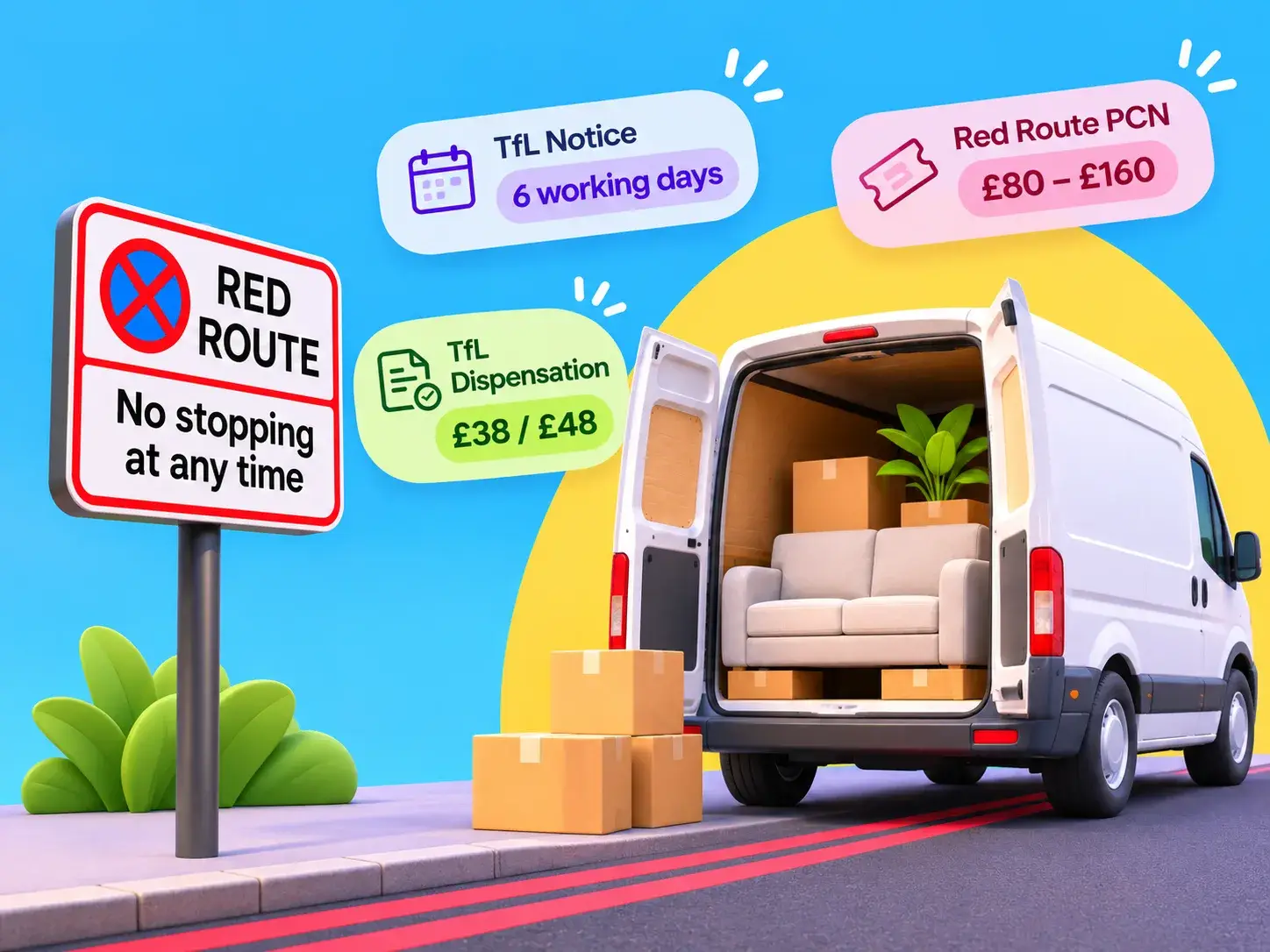
- TfL runs its own dispensation for house moves: £38 a day to stay in a bay past its limit, £48 a day to stop on red lines, with at least 6 working days' notice. Red-line permits are granted only in exceptional cases.
- A red route PCN is £160, or £80 if paid quickly, and rises to £240 and then £250 if it is ignored. Cameras enforce it as well as officers.
- If the van has to park round the corner, the walk is paid time. On a 2-bed second-floor flat, our assumed extra hour of carrying costs £280, more than most side-road suspensions.
- Tell us at quote stage if either address is on a red route, with a photo of the nearest bay sign. You apply and pay for any suspension or dispensation; we plan the van and crew around it.
On this page14 sections
Red routes are London's main roads, and they are the one place where a removal van cannot simply stop outside the door with its hazard lights on. The lines are red instead of yellow, the rules are set by Transport for London rather than the borough, and the cameras are watching. If your home fronts one, where the van stops decides how long the move takes and what it costs.
This guide goes past the basic rule in our road charges guide. It explains every red line and box and what a removal van may do at each, how TfL's little-known dispensation for house moves works, how a red route penalty escalates, and, with our own rate card, what each stopping place costs on a real London flat move.
What is a red route, and who runs it?#
TfL manages the Transport for London Road Network, or TLRN, which is the network of major roads widely known as red routes. TfL says they make up about 5% of London's roads but carry up to 30% of the city's traffic. They are red because they are TfL's roads: the lines replace the yellow lines that the boroughs use on everything else.
The original list of these roads is in the GLA Roads Designation Order 2000, which made them Greater London Authority roads from 3 July 2000. It includes long stretches of the A1, A2, A3, A4, A10, A12, A13 and A40, much of the A205 South Circular, and the A406 North Circular. The network has been changed since 2000, so do not rely on the order for any single street. TfL's interactive red route map is the place to check a road today.
Two details catch people out. First, TfL says that most roads with a painted red line are its own, but a small number are run by local authorities. Some boroughs now use red routes on their own roads, especially on major bus routes, and a penalty on a borough red route goes to that borough, not to TfL. Second, a red route is only the main road itself. The side roads off it, with their yellow lines, pay bays and residents' bays, belong to the borough, and the borough's rules apply the moment the van turns the corner.
Croydon is a good example of a borough that names its red routes on its own website; our moving to Croydon guide lists them and what they mean for a move there.
How do you know if your address is on one?#
The quickest test is the paint and the signs outside your door. If the kerb has red lines, or if there are no lines at all but a sign says you are on a red route clearway, you are on a red route. Then check three things.
- The sign nearest your door. TfL's loading page says its signs generally have three parts. The top tells you that you are on a red route. The middle tells you when the rules apply, and TfL notes that these times differ from borough to borough. The bottom tells you the times and the activity each bay can be used for, such as loading
- The nearest box. Look along the road for a marked bay, its colour and its sign. A bay 30 metres away may be the difference between loading outside and loading round the corner
- The side road. Note the nearest side road, whether it has bays or yellow lines, and which borough it is in. That is your fallback, and often your best option
Do this at both addresses. A move can start on a quiet residential street and end on a red route, and it is usually the unloading end that people forget, because they have not yet stood outside the new home with a removal in mind.
When you send us a quote request, a photo of the nearest bay sign and a photo of the kerb outside the door save a lot of back and forth. The same photos are what TfL or the council will want if you apply for a permit.

Red line types: what a removal van may do at each#
The rules are spread across several TfL pages and the Highway Code. Here they are in one place, with the question that matters on moving day: can the van stop and load here?
| Marking or bay | What it means | Can a removal van stop to load? |
|---|---|---|
| Red route clearway sign, often no red lines | No stopping at any time, 24 hours a day, every day. Stopping only in marked bays | Only in a marked bay, if there is one |
| Double red lines | No stopping at any time. No time plate is needed | No, unless TfL grants a dispensation, which it does only in exceptional cases |
| Single red line | No stopping during the hours on the nearby sign | Outside those hours only, and only for as long as the sign allows |
| Bus stop: double or wide red line with a yellow box | A bus stop or stand | No |
| Red dotted box with a loading sign | Loading at the times on the sign, usually outside peak hours | Yes, at those times, for up to the maximum shown |
| White dotted box with a loading sign | Loading generally all day, usually with a maximum time | Yes, for up to the maximum shown |
| Box with a P sign | Parking at the times and for the length shown, with a no-return period | Yes, within those limits. Loading is also allowed in parking bays |
| Pavement, crossover or zigzags | Red lines cover the pavement and verge too. No pavement parking anywhere in London | No |
The table draws on TfL's pages on red lines and no stopping, loading and parking, and on the Highway Code's road markings. Four points are easy to miss.
- Red route clearways have no lines. TfL says its clearways are not shown by red lines, except at some roundabouts and junctions. The only clue is the sign. Rule 240 of the Highway Code says you must not stop on a clearway
- The red lines cover the pavement. The Highway Code says red lines apply to the carriageway, pavement and verge. Mounting the kerb does not get the van off the red route. Rule 244 also says you must not park partly or wholly on the pavement anywhere in London
- A single red line is not a loading line. It allows stopping only outside the hours on its sign, and only for as long as the sign says
- There is no removals exemption. TfL's exemptions cover Blue Badge holders, taxis and private hire vehicles. A removal van is treated like any other vehicle
How long can a van stay in a red route loading bay?#
As long as the sign allows, and no longer. TfL says it will allow reasonable time for collecting goods and checking paperwork, but as soon as loading is finished the vehicle must move. The goods must be ready when you enter the bay. TfL's own example of goods that justify a vehicle is an item of furniture such as a chest of drawers, so a house move is plainly loading. What TfL does not give is a number of minutes. The maximum is whatever the bay's sign says.
That matters because bay limits are short compared with a house move. The Highway Code's own example of a red route loading sign shows loading allowed for up to 20 minutes. That is one example sign, not a London rule: some bays allow longer and some are only open between the peaks. But it shows the scale. Our quote form allows these loading times:
- 1-bedroom home: 2 hours of loading, and the same again to unload
- 2-bedroom home: 3 hours of loading, and the same again to unload
Even the shortest of those is several times longer than a typical bay limit. A full home will rarely fit inside one. TfL also says not to stay in the bay once loading is done, and not to use it outside the hours on the sign or for longer than permitted, so moving the van out and back in to reset the clock is exactly what the rule is written to stop.
Red boxes and white boxes
A box marked with a red dotted line can be used only outside peak traffic hours, and TfL warns that peak hours vary from area to area and even from road to road. A box marked in white can generally be used all day, though there is usually a maximum time. The Highway Code says the same: a red box is available for its purpose for part of the day, a white box throughout the day. Read the sign, not the colour.
What to do while the van is in the bay
TfL suggests making it obvious that you are loading if the vehicle is left unattended, and telling any civil enforcement officer that you are loading. On our moves the crew does this. What helps from you is having everything packed, sealed and near the door before the van pulls in, because TfL expects goods to be ready when the vehicle arrives, and a bay is not a place to wait while the last boxes are taped.
How red routes are enforced#
TfL enforces in two ways. A civil enforcement officer can issue a penalty charge notice on the spot, or TfL can use CCTV cameras, in which case the PCN arrives later by post. TfL's red routes page says a PCN for these offences is £160 if paid within 28 days, cut to £80 if paid within 14 days.
If a PCN is ignored, TfL's enforcement process for parking notices runs in stages:
- The PCN: £80 within 14 days, £160 within 28. A notice sent by post after a camera recording gets 21 days at the discounted rate
- A Notice to Owner, sent to the registered keeper, if the PCN is not paid or challenged
- A Charge Certificate, which raises the charge by 50% to £240
- An Order for Recovery, once the debt is registered at the Traffic Enforcement Centre, which adds a £10 fee and makes it £250
- A warrant, after which enforcement agents add their own fees
At each stage you can challenge the notice, first with TfL and then with an independent adjudicator at London Tribunals. Writing to TfL within the discount period holds the charge at £80 while it considers the challenge. The best defence, though, is a permit you can show: a dispensation is valid only while it is on display in the vehicle.
The camera point is the one that changes behaviour on moving day. On a yellow line, a crew can often see an officer coming. On a red route, the first sign of a problem may be a letter two weeks later. That is why we plan the stopping place before the day rather than looking for a gap when the van arrives.
TfL's dispensation for house moves#
This is the part most people do not know about. TfL says that in special circumstances it can relax the parking rules on its red routes, and the first example it gives is moving house. The permit is called a dispensation, and it is TfL's equivalent of a council suspension or dispensation. You need one if you want to load or unload for longer than a bay's time limit, or to park on red lines during restricted hours.
What it costs
- £38 a day per vehicle to stop in a loading or parking bay
- £48 a day per vehicle to stop on a single or double red line
- Payment is taken by card once the application is approved. You are not charged if it is refused
- TfL says it may waive the charges for certain activities, at its discretion
Set against the council fees later in this guide, a red route dispensation is cheap. The catch is not the price but the conditions.
When TfL says no
TfL says a dispensation may not be granted where reasonable parking alternatives are available, or simply for convenience. For deliveries, it expects loading to happen in nearby parking or loading bays rather than immediately outside the property. A permit to stop on single or double red lines is granted only in exceptional circumstances. TfL's examples are putting up scaffolding and moving heavy items, and it says these can need a review by its traffic engineers and even a site visit.
In practice, that means the bay dispensation is the realistic one for a house move: it lets the van stay in an existing bay near your door for longer than its sign allows. A red-line dispensation outside the door is worth asking for when there is genuinely nowhere else, for example a piano or a very heavy item with no bay or side road within reach, but do not plan the move around getting one.
How to apply
TfL needs at least 6 working days, counting the day it receives the request. You apply by phone on 0343 222 3333, choosing option 2 and then the star key to speak to an adviser; the lines are open 08:00 to 20:00, Monday to Friday. Have this ready:
- The date and time you need the dispensation
- The reason, which is a house move
- The precise location: street name and the number or name of the next-door property
- The red route controls at that spot, which is why the photo of the sign helps
- Your contact details, including an email address
- A description of the vehicle, for example a van or a lorry
TfL does not need the number plate when you first call. Once it approves the request, it asks for the registration, make, model and colour, then takes payment and emails a permit to display on the dashboard. As with a parking suspension, the application and fee are yours, so tell us as soon as you have applied and we will send you the vehicle details for the booked van.
If the date changes
TfL does not refund a permit once it has been approved and issued, even if it is not used. It will consider re-issuing it once, with at least one working day's notice before the original start date and the new details at the time you ask. If your completion date is not yet fixed, apply as late as the 6-working-day notice allows, not as early as possible.
If TfL refuses, it says it will try to offer an alternative time or location. An alternative time can be useful: a bay that is closed in the morning peak may be open from mid-morning, which is often when a removal crew is ready to load anyway.
Borough red routes and the councils' part#
Because red routes belong to TfL, the councils mostly stay out of them. Our parking rules records show Haringey saying it does not suspend red routes and that requests go to TfL, and Islington saying it is not responsible for suspensions on red routes. Hackney is the same, as our moving to Hackney guide explains.
The exception is a borough red route. If the red lines outside your door are on one of the few red routes a borough runs on its own roads, the rules, the penalties and any permission come from that borough, not TfL. The signs should say which; if they do not, ask TfL's red routes team on the number above before you apply to anyone.
Whichever road it is, the side street round the corner is almost always the borough's. That is where the council's own suspension and loading rules come back in, and where the borough comparison in suspension or dispensation is useful.
Your address is on a red route: what to do#
Your address is on a red route
Check whose road it is
Red lines and a red route sign mean TfL in almost every case. A borough red route is run by that borough. Look the road up on TfL's red route map if the signs are unclear.
Find the nearest box and read its sign
Note the colour, the hours and the maximum stay. Photograph the sign and the kerb outside your door.
Compare the limit with the job
A 1-bedroom home takes about 2 hours to load on our quote form, a 2-bedroom home about 3 hours. If the bay's limit is shorter, it will not hold the van for the whole job.
Ask TfL for a bay dispensation
If a bay is close, ask TfL for £38 a day to stay past the limit. Allow at least 6 working days. Red-line permits are for exceptional cases only.
Look at the side road
If no bay is close, or TfL says no, find the nearest side road and check its borough's suspension rules and notice period.
Book the side-road suspension
You apply and pay. Most London councils want 7 to 14 days. Ask for the space nearest the corner.
Tell us at quote stage
Send both postcodes, the photos and what you have booked. We plan the van, the crew and the carry around it.
Bay, side road or round the corner: what each one costs#
Every minute the crew spends walking between the van and your door is part of the job's time, and the time is charged by the hour from arrival. Upstairs, it costs twice: our stair charge is £10 per person, per flight, for each hour at that address, so a longer carry to a flat also means more stair time. Here is what each stopping place costs on four typical London moves of 5 miles, priced with our rate card and the rounding our quote form uses.
| Where the van stops | Extra carrying (our assumption) | Permit fee | 1-bed, ground floor | 1-bed, 2nd floor, no lift | 2-bed, ground floor | 2-bed, 2nd floor, no lift |
|---|---|---|---|---|---|---|
| Red route loading bay outside, load fits the sign's limit | None | None | £0 | £0 | £0 | £0 |
| Same bay, TfL dispensation to stay past the limit | None | £38 a day (TfL) | £0 | £0 | £0 | £0 |
| Red line outside, TfL dispensation (exceptional cases only) | None | £48 a day (TfL) | £0 | £0 | £0 | £0 |
| Suspended bay in the nearest side road | 30 min | Council fee, £48 to £360 below | +£50 | +£90 | +£80 | +£140 |
| Any legal space found further away, no permit | 1 hour | None | +£100 | +£180 | +£160 | +£280 |
The extra carrying times are our assumptions, not measurements. We have assumed a suspended bay in the nearest side road adds 30 min of carrying in total at the red route address, and that a van left to find any legal space further away adds 1 hour. Your street may be better or worse: a side road ten metres from your door adds very little, and a long main road with no side turnings for 200 metres adds more. The rate card figures are exact; the walking time is the estimate. The base moves are a 1-bedroom home in the Luton Box Van with 2 movers at £459, and a 2-bedroom home in the 5.5 Tonne Lorry with 3 movers at £1,050, before stairs.
What the table shows
- The bay outside is worth fighting for. At £38, a TfL bay dispensation costs less than even 30 min of extra carrying on any of the four moves
- Stairs make the carry dearer. On the 2-bed second-floor flat, 1 hour of extra carrying costs £280, against £100 on a 1-bed ground-floor flat. The difference is the stair charge on the extra time
- A guaranteed space beats a hopeful one. On the 2-bed second-floor flat, moving from "whatever we find" to a suspended bay at the corner saves about £140 on our assumptions. That is the figure to set against the council's fee
- Waiting is charged too. If the crew has to stand by while a space is found, waiting time is £40 per crew member per hour
These are estimates for addresses we have not seen. Your written quote is built on your own inventory and access, and our team confirms the final price in writing. For how the stair charge works on its own, see the removal stairs charge explained.
What a side-road suspension costs#
If the van has to go round the corner, a suspension reserves a space there. These are the one-space, one-day costs for a sample of London councils, from our parking suspension finder, as the councils' own pages stated them on 3 November 2026. Several councils cut the fee for a house move.
| Council | One space, one day | What the figure is | Notice |
|---|---|---|---|
| Newham | £48 | £25 admin + £23 for one bay | 10 working days |
| Camden | £66.66 | moving home: £66.66 admin, first-day space charge waived | 17 days advised. 3 days minimum |
| Croydon | £81 | residents: £46 admin + £35 a day outside the central CPZ | 10 working days |
| Hackney | £100 | moving home: £100 admin, bay fee waived on day 1 (Hackney's page also shows £96.50; confirm when you apply) | 7 working days |
| Southwark | £146.15 | £93 admin + £53.15 for one space | 7 days |
| Lambeth | £156.38 | £98.83 admin + £57.55 for one space | 10 working days standard |
| Haringey | £360 | £280 admin + £80 for one space | 2 weeks |
Set those against the table above. For a ground-floor 1-bed with a short walk, a £360 suspension in Haringey may cost more than the carrying it saves, and a TfL bay dispensation or a careful choice of loading time may be the better route. For a 2-bed on the second floor, even a mid-priced suspension is close to the £140 saving on our assumptions, and it removes the risk of finding no space at all, which is the outcome that really costs money.
Some side roads need no suspension. Our records show Hackney letting domestic removals load on single and double yellow lines for up to 40 minutes of continuous loading, and Islington letting clearly branded removal vehicles use a single yellow line or a resident bay while loading is continuous. Those rules are for the borough's roads, not the red route, and our controlled parking zone guide explains how to read the yellow lines and zone signs once the van is off the main road.

Timing the move around the red route#
Red route rules change through the day, and the times are set road by road. That gives you one more lever: the start time.
- Red boxes open between the peaks. If the nearest box is red, find out when its loading window opens and plan the crew's arrival for then. TfL says peak hours vary from road to road, so read the sign rather than assuming
- Single red lines relax at some hours. A single red line allows stopping outside the hours on its sign. On some roads that covers the evening or Sunday, but our rate card adds 15% for evenings and 20% for Sundays and bank holidays, so weigh that against a suspension
- Both ends have their own rules. The van reaches the second address hours after it leaves the first. A load timed to a morning window can mean an unload in the afternoon peak somewhere else
- The Congestion Charge is separate. If either address is in the zone during charging hours, it is added to the quote as its own line, whatever happens with parking. The road charges guide has the hours
If timing is tight, a London house removal quote with both postcodes and the bay photos lets us suggest the start time that fits both signs.
What to send us, and what we do#
Tell us at quote stage if either address is on a red route. It changes the plan more than almost anything else about a London address. With it, send:
- Both postcodes and the date you have in mind
- A photo of the kerb outside each door and of the nearest bay sign
- The nearest side road at each end, and whether it has bays or yellow lines
- Any suspension or dispensation you have applied for, with its reference and times
- The floor, the lift if there is one, and the walk from the kerb to the door
You get an itemised written quote within 24 hours. On a red route, the access is priced openly: if the van has to stop further away, the carrying is in the hours, not hidden in the rate. Under our quotation terms, you apply for and pay for any parking suspension or dispensation, and we plan the van and crew around it. Every move also includes:
- Goods in Transit cover. Included on every move, not sold as an add-on.
- Public Liability cover. In place on every job, at home or at work.
- Our own crew. Every mover is employed by AFS. We never pass your move to a subcontractor.
- One named coordinator. Your single point of contact, from the quote to the last box.
Start from our house removals in London page, or message us on WhatsApp on +44 333 772 3714 with the photos. The final price is confirmed by our team in writing before the move.
Frequently asked questions
Can a removal van stop on a red route?
How long can you load in a red route loading bay?
Can I get permission to park a removal van on a red route?
How much is a red route PCN?
Can the council suspend a bay on a red route?
Who pays for a red route dispensation on an AFS move?
Sources and further reading
- Transport for London:TfL's red routes
- Transport for London:Rules of TfL's red routes
- Transport for London:Red lines and no stopping
- Transport for London:Loading for the public
- Transport for London:Parking on red routes
- Transport for London:Dispensations on TfL's red routes
- Transport for London:Penalty Charge Notices: enforcement process
- Transport for London:Red route exemptions
- GOV.UK:The Highway Code: waiting and parking (rules 238 to 252)
- GOV.UK:The Highway Code: road markings
- legislation.gov.uk:The GLA Roads Designation Order 2000 (SI 2000/1117)
- AFS Removals:London parking suspension rules, by council
Every source was read on . Our prices come from our published rate card.
Written and maintained by
JohnMoving home and London specialist
John writes AFS Removals' guides on moving home and on moving in London: parking suspensions, controlled parking zones, boroughs, tower blocks, concierge buildings and renting. These guides are based on AFS Removals' published services and on the official council and government sources each guide cites.
- Published
- Sources checked
- Prices from our published rate card
Ready to plan your move?
Send both postcodes and a photo of the nearest bay sign. Your itemised written quote plans where the van stops and prices the carry openly.
Get a London house removal quote